
 Close
Close


Running a small or medium-sized business means wearing a dozen hats at once, and IT security can easily slip down the priority list until something goes wrong. But here’s the good news: protecting your business doesn’t have to be overwhelming or expensive. With the right IT partner and a clear strategy, you can turn cybersecurity, compliance and data protection from a source of stress into a genuine competitive advantage. This guide breaks down the top IT concerns facing businesses today, explains why they matter, and shows you exactly how a structured approach to IT consulting, management and infrastructure can keep your business safe, compliant and ready to grow.
Key takeaways
- Cybersecurity is the top concern for 68% of organisations, making it the single biggest priority for SME technology budgets.
- Data loss remains a major threat, with 51% of businesses saying they’d invest more in security after a breach.
- Compliance isn’t optional: 76% of risk and compliance professionals say it’s critical to business operations.
- Privacy investments pay off, with 96% of businesses recognising their importance and 73% of leaders confirming that privacy regulations reduce cyber risk.
- A structured IT approach — Consult, Design, Implement, Manage — gives SMEs enterprise-grade protection without enterprise-level complexity or cost.
What are the biggest IT concerns for UK SMEs?
Small and medium-sized businesses face the same digital threats as large corporations, just without the same budgets or in-house expertise to handle them. That gap is exactly why so many SMEs feel like they’re playing catch-up with technology. Here’s a snapshot of what’s keeping business leaders up at night:
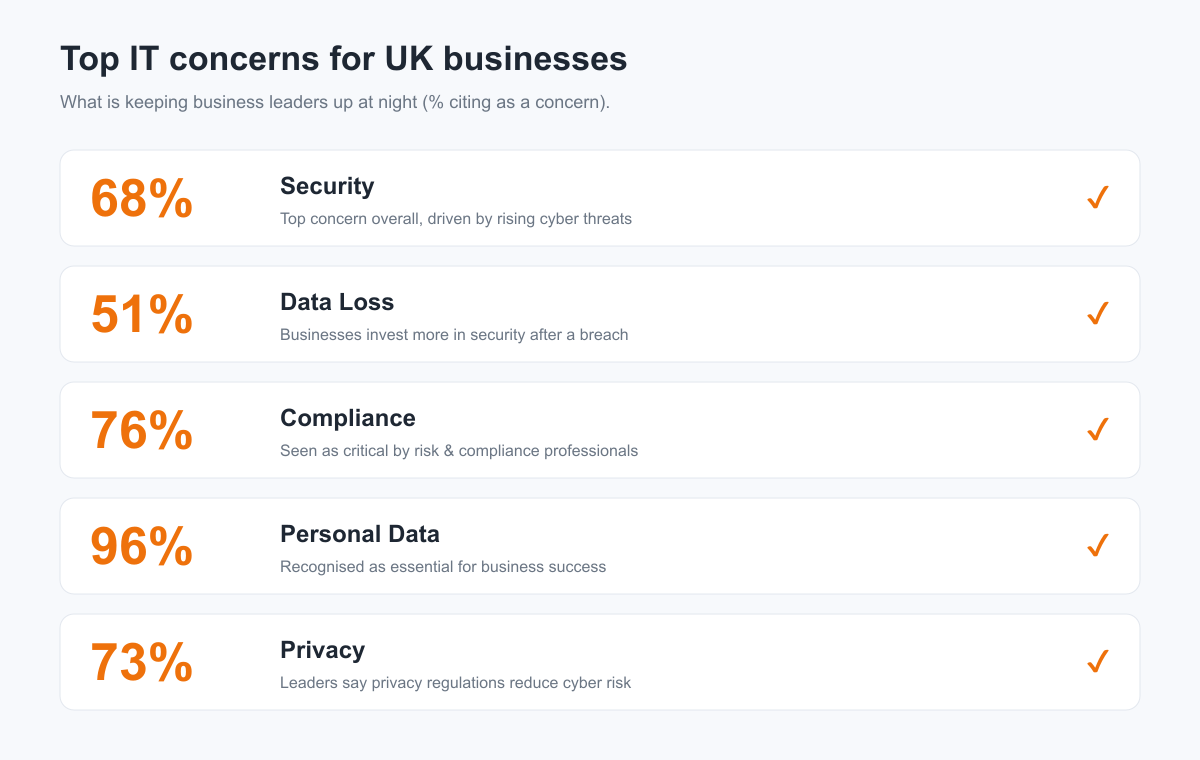
These numbers tell a clear story: technology risk has moved from an IT department problem to a boardroom priority. If your business hasn’t reassessed its IT strategy recently, now’s a great time to start.
Why is cybersecurity the top concern for 68% of organisations?
Cybersecurity tops the list because the threat landscape keeps evolving, and attackers increasingly target smaller businesses precisely because they assume weaker defences. With 68% of organisations citing security as their primary concern, it’s clear that businesses of every size recognise the stakes. For SMEs, this often means:
- Limited in-house expertise to monitor networks around the clock
- Legacy systems that haven’t been updated to handle modern threats
- Growing attack surfaces as teams adopt more cloud tools, remote work and connected devices
A proactive IT management partner changes this equation entirely. Instead of reacting to incidents after they happen, continuous monitoring and support catch vulnerabilities before they become full-blown breaches.
What happens after a data breach, and why does it matter?
After a data breach, 51% of businesses say they would invest more in security — a statistic that reveals an uncomfortable truth: many companies only take data loss seriously once it’s already cost them something. Data loss can happen through ransomware attacks, hardware failure, human error or even natural disasters, and the financial and reputational fallout often outweighs the cost of prevention many times over. Rather than waiting for a wake-up call, SMEs can get ahead of data loss with:
- Automated, regularly tested backups stored both on-site and in the cloud
- Clear recovery protocols so your team knows exactly what to do if something goes wrong
- Infrastructure audits that identify single points of failure before they cause downtime
How important is compliance for modern businesses?
Compliance plays a critical role for businesses today, with 76% of risk and compliance professionals emphasising its importance. Whether it’s data protection regulations, industry-specific standards or contractual obligations with partners and clients, compliance has become a core part of doing business responsibly. For SMEs, compliance can feel like a moving target — regulations change, client requirements evolve, and keeping documentation current takes real effort. The businesses that treat compliance as an ongoing process, rather than a one-time checkbox, are the ones that avoid costly penalties and maintain trust with their customers.
Why do businesses need to invest in personal data protection?
An overwhelming 96% of businesses recognise that protecting personal data is essential to long-term success. This isn’t just about avoiding fines; it’s about preserving customer trust. When clients hand over their personal information, they’re trusting a business to safeguard it. A few practical ways businesses strengthen personal data protection include:
- Encrypting sensitive data both in transit and at rest
- Limiting data access to only those employees who genuinely need it
- Regularly reviewing what data is collected and whether it’s still necessary
Do privacy regulations actually reduce cyber risk?
Yes. According to industry data, 73% of organisational leaders acknowledge that privacy regulations are effective at reducing cyber risk. Rather than viewing privacy laws as red tape, forward-thinking businesses treat them as a framework for building stronger, more resilient systems. Privacy regulations typically require businesses to understand exactly what data they hold, where it’s stored and who can access it. That level of visibility naturally makes it harder for bad actors to exploit gaps, and easier for IT teams to spot unusual activity before it escalates.
How can SMEs build a stronger IT strategy without a massive budget?
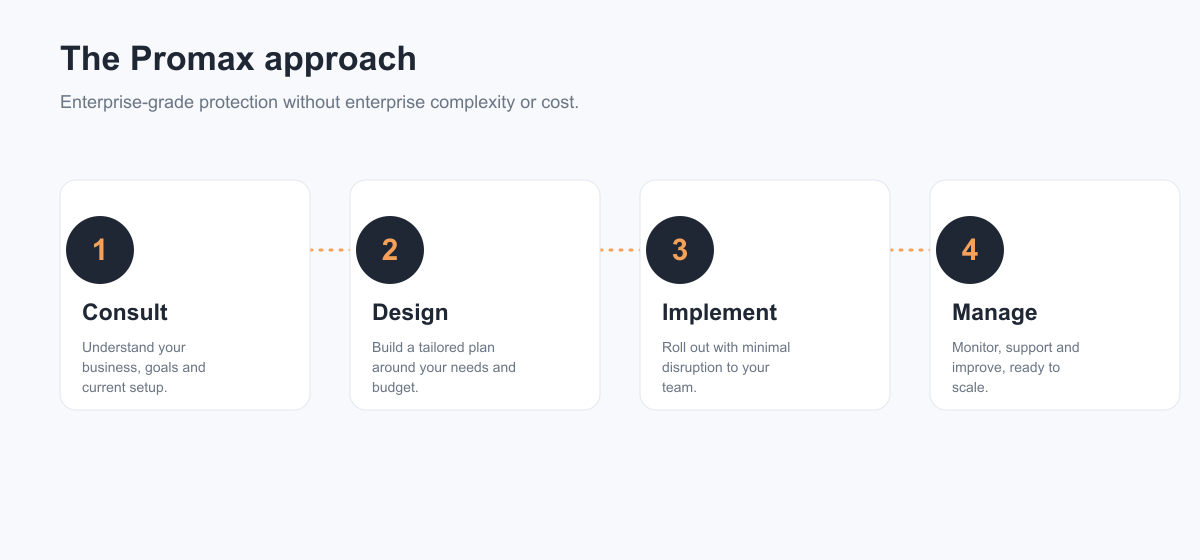
Here’s the good news: you don’t need an enterprise-sized budget to get enterprise-level protection. What you need is a structured, practical approach tailored to your business. That’s exactly the philosophy behind Promax IT Solutions’ four-step approach: Consult, Design, Implement, Manage.
Consult: understanding your business first
Every strong IT strategy starts with listening. Promax takes the time to understand your business, your goals and your current technology setup, pinpointing exactly where technology can add the most value rather than applying a one-size-fits-all fix.
Design: building a plan around your needs
Once the picture is clear, the next step is designing a tailored IT solution that fits your budget and growth plans, without unnecessary complexity. This means you’re not paying for tools or services you don’t actually need.
Implement: rolling out with minimal disruption
Change can be disruptive if it’s not handled carefully. Promax’s engineers deploy and configure new systems — from networks to Microsoft 365 security — with minimal interruption, so your team keeps working while the technical heavy lifting happens behind the scenes.
Manage: keeping systems secure and ready to scale
IT isn’t a “set it and forget it” job. Ongoing monitoring, support and improvement keep your systems secure, reliable and ready to grow alongside your business. Security and data loss are tackled through proactive management; compliance and privacy are built into the design phase from the start, rather than bolted on as an afterthought.
Your next step toward a safer, smarter business
Technology risk isn’t going away, but it doesn’t have to be a constant source of worry either. With the right consulting, management and infrastructure support in place, SMEs can tackle security, compliance and privacy challenges head-on — and even turn them into a competitive edge. Because when customers know their data is safe with you, that trust becomes one of your most valuable business assets.
If you’re ready to take a proactive approach to your business’s technology, Promax IT Solutions is here to help. Get in touch with our team today and let’s start the conversation.
Frequently asked questions
What IT services does Promax offer for SMEs?
Promax provides a full range of services across IT consulting, IT management and IT infrastructure. Together, these help small and medium-sized businesses build, implement and maintain secure, scalable technology systems.
How much does IT consulting typically cost for a small business?
Costs vary depending on the scope of services, business size and current infrastructure. A consultation with Promax typically starts with an assessment of your business goals and existing setup before recommending a tailored, budget-conscious solution.
How long does it take to implement a new IT infrastructure?
Implementation timelines depend on the complexity of the project, but our structured Consult, Design, Implement, Manage process is designed to minimise disruption so your team can keep working throughout the transition.
What are the risks of not investing in cybersecurity?
Businesses that underinvest in cybersecurity face a higher risk of data breaches, financial loss, regulatory penalties and reputational damage. With 68% of organisations citing security as a top concern, the risk of inaction continues to grow.
Who is responsible for compliance within a small business?
While leadership typically holds ultimate responsibility, compliance works best as a shared effort between leadership, IT and any external partners managing data and systems. An experienced IT management partner can help ensure compliance requirements are met consistently.
Leave a Reply